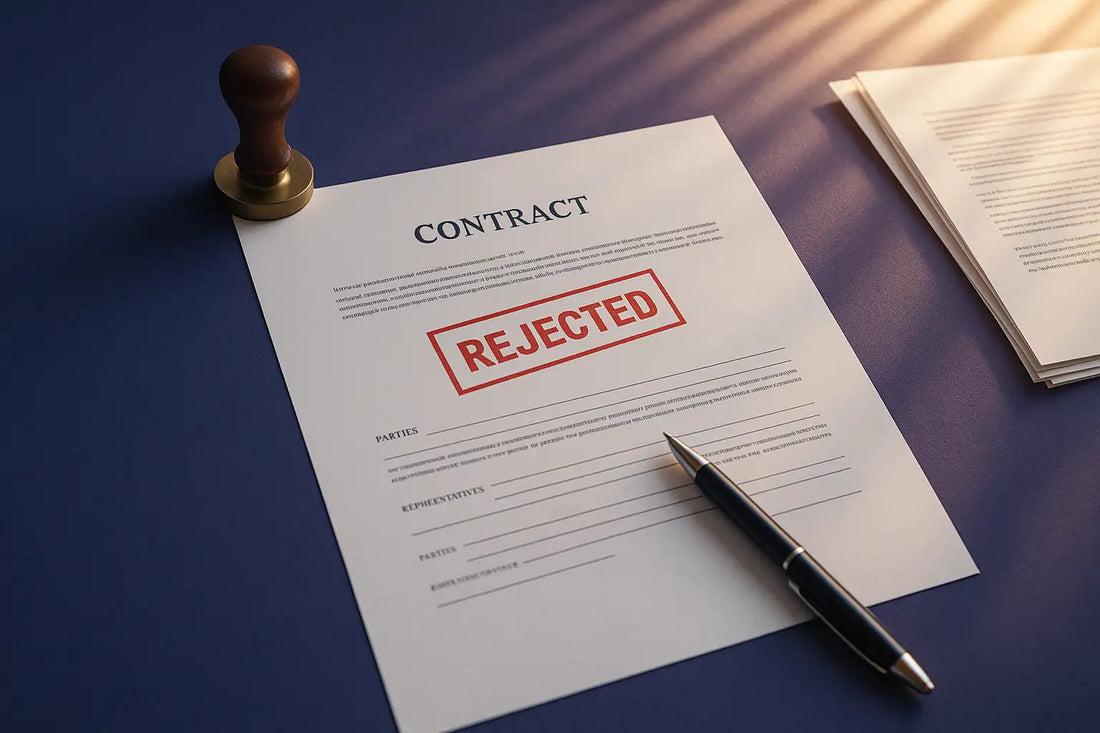
It's a situation no one wants to experience: You've invested time, money, and effort in a certified translation, only to hear from the authorities: "Unfortunately, we cannot accept this translation." The frustration is understandable – especially when important deadlines for your application, naturalization, or other official matters are at stake.
But don't worry! In this blog post, we'll explain why certified translations are sometimes rejected and – more importantly – what you can do about it.
Table of Contents
Definition of certified translations
Before we get to the problems, it is important to understand what a certified translation actually is:
A certified translation is a translation that has been prepared by a state-authorized translator and officially confirmed by a certification statement with a stamp and signature. It confirms the accuracy of the translation in terms of content and language.
The 3 most common stumbling blocks when submitting documents to authorities
Here you can find out what authorities most often object to:
Incorrect translator qualification
A common pitfall: The person who produced your translation is not officially authorized. Unlike regular translations, certified translations cannot be obtained from a simple language school or a bilingual friend – even if they have excellent language skills.
Table chaos and layout problems
Especially with academic documents like certificates or transcripts, the structure is often neglected. If your grades are presented in a confusing passage of text instead of a clearly structured table, the authorities cannot properly interpret the information.
The technical term trap
Especially with legal or medical documents, a single incorrectly translated technical term can ruin everything. A typical example is the translation of foreign professional or educational qualifications. Literally translating "Bachelor of Engineering" as "Bachelor of Engineering" might be technically correct, but it's obviously nonsensical.
Step-by-step: What to do if your certified translation has been rejected?
If you have already received a rejection, here are the specific steps you should take now:
Ask for the exact reason.
Here's how to proceed:
- Contact the authority by phone or email.
- Write down the name of your contact person.
- Please provide a written explanation for the rejection.
- Inquire about specific requirements for an accepted translation
Have the document revised
In case of formal deficiencies:
- Provide all the information to the translator.
- Have the corrected version sent to you (digitally and as a hard copy).
- Check the new version for completeness.
- Submit the corrected translation to the authority.
In case of factual errors:
- Make sure the translator has understood all the corrections.
- Please provide a complete new translation if necessary.
- Check the new version carefully before submitting it.
Have a new translation done
If the flaws are serious or the original translator was not qualified, sometimes a completely new translation is the fastest way.
Here's how to proceed:
- Find a demonstrably sworn translator (see ordering process below)
- Inform the new translator why the previous translation was rejected.
- Submit all necessary documents in the best possible quality.
- Please request an express service if deadlines are pressing.
- Check the new translation before submitting it.
This way you can avoid problems from the start.
These tips will help ensure that your certified translation is accepted from the start:
Choose a qualified translator
Check the qualification:
- In the database of the regional court districts (publicly accessible)
- Via the website of the Federal Association of Interpreters and Translators (BDÜ)
- By inspecting the translator's authorization certificate
Communicate the intended use
Here's how to do it right:
- Inform the translator in writing about the exact purpose of the translation.
- Name the authority to which the document should be submitted.
- Inquire about specific requirements for this purpose
- Clarify whether additional authentications (e.g., apostille) are required.
Delivering high-quality originals
Here's how to prepare your documents:
- Make sure all pages are fully visible.
- Make sure that stamps, seals and signatures are clearly legible.
- Add clear numbering to multiple documents.
Check the completed translation.
Checklist for inspection:
- Have all pages of the original been translated? (Compare the page numbers)
- Are the name, date of birth, and other personal details correct?
- Are the translator's stamp and signature clearly legible?
- Was the original document described correctly?
Quality characteristics of a correct certified translation
A correct certified translation should have these characteristics:
Formal completeness
- Certification statement with exact wording
- Stamp of the authorized translator
- Handwritten signature (not a digital signature)
- Date
Content accuracy
- Precise translation of all relevant content
- Correct use of technical terms
- Notes on untranslatable elements (e.g. coats of arms, certain stamps)
Structural clarity
- A comprehensible reproduction of the original structure
- Clear labeling of headings, sections, tables
- Regarding report cards : maintaining the grade and subject structure.
Professional design
- Clean layout without typos
- Uniform formatting
- High-quality paper
- Visible and easily legible stamps and signatures
Use cases with examples
Example 1: Rejection of a birth certificate translation at the registry office
Situation: Maria wants to get married in Germany and submits her translated foreign birth certificate to the registry office. The translation is rejected.
Problem: The translator had not translated the watermark and a marginal note on the original document.
Solution: Maria contacted the translator, who produced a complete new translation including all elements. This was accepted by the registry office.
Example 2: Rejected translation of a certificate at a university
Situation: Ahmed applies for a Master's program in Germany and submits his translated certificates. The university rejects the translation.
Problem: The musical notation translation was incorrect. The translator had not explained the foreign grading system, making a comparison with the German system impossible.
Solution: Ahmed commissioned a translator specializing in academic documents, who produced a new translation with an explanation of the grading system and a comparison to the German scale.
Ordering process at Beglaubigung24
We guarantee you'll receive officially recognized certified translations. Here's how the ordering process works:

Why customers trust us
Frequently Asked Questions
Minor formal errors can often be corrected within 1-2 business days. For content errors or if a new translation is necessary, you should allow 3-5 business days.
No, only state-authorized translators are allowed to produce certified translations in Germany – regardless of your language skills.
Registry offices, immigration authorities, and universities often have particularly high requirements. Extra care should also be taken with international documents requiring apostilles.
The legal recognition of digitally certified translations varies depending on the authority. Many authorities now accept digital versions, while others still insist on original paper copies. If in doubt, check with the authority beforehand.
For international recognition, you usually need additional authentication in the form of an apostille or legalization.
The costs are generally the same as for a standard certified translation. However, some providers offer a discount if you submit the rejected translation.
What customers say about their experience with us:
"For my naturalization, I needed a certified translation of my birth certificate. The first translation was rejected by the registry office. With Beglaubigung24, I received a new translation within just 3 days, which was accepted without any problems. The customer service was extremely helpful and explained to me exactly what was missing from the first translation."
"When I urgently needed to have all my certificates translated for an application to the University of Frankfurt, Beglaubigung24 really helped me. A previous translation was rejected by the university because the grading scale wasn't explained correctly. Beglaubigung24 immediately understood the problem and delivered a perfect translation that was accepted without any issues."